
Buying a reliable used car means weighing up three factors before you even look at a listing: your daily driving habits, your total budget (purchase, insurance and maintenance), and the powertrain that best suits your needs. Overlook any one of these and you could end up with a car that costs more to run than it did to buy.
Used-car powertrains: petrol, diesel or electric based on your actual mileage
Do you drive fewer than fifteen thousand kilometres a year, mostly in town? A petrol engine costs less to buy and is better suited to short journeys. Diesel remains a good option for high-mileage drivers, but its higher purchase price only pays off once you cover a substantial number of kilometres each year.
Used electric cars are appealing because of their low running costs. Before you sign, check one thing many buyers overlook: the battery state-of-health certificate (SOH). This document shows the battery’s remaining capacity compared with its original capacity. Make sure it includes the vehicle’s VIN, the date of the assessment and the measurement method used.
An SOH reading from the vehicle’s onboard management system is not always comparable with one from an independent test. Two listings showing a similar SOH may conceal different realities if the readings were obtained using different methods. To compare them, check the capacity reference and the test conditions.
Another point to bear in mind: from 2027, a digital battery passport accessible via QR code is expected to bring together the battery’s history and state of wear. This regulatory change will make it easier to compare used electric cars, although some information will remain self-reported.
If you’re looking for a petrol, diesel or electric vehicle with a documented history, the cars offered by Jb Autos and JB Motor cover several segments, from city cars to SUVs.

Used-car budget: calculate the total cost, not just the purchase price
The price shown in the listing is only part of the expense. A car bought at a low price can prove costly if it hasn’t been properly maintained or is due for major servicing.
Before setting your budget, list the actual costs:
- The purchase price, compared with online valuations for the same model and year with similar mileage
- Immediate additional costs: registration, any required roadworthiness test, and delivery or preparation fees if you buy from a dealer
- Expected maintenance costs over the next two years: timing belt, tyres, brakes and oil changes, according to the service schedule
A well-maintained car at an average price is better than an apparent bargain with no service history. Always ask for the service book and invoices for previous work. Missing documents should be a warning sign, whatever the price.
Roadworthiness test and inspection: what you can check yourself
The mandatory roadworthiness test lists any faults found, but it doesn’t cover everything. Some points deserve your attention, even if you’re not a mechanic.
Visual checks before the test drive
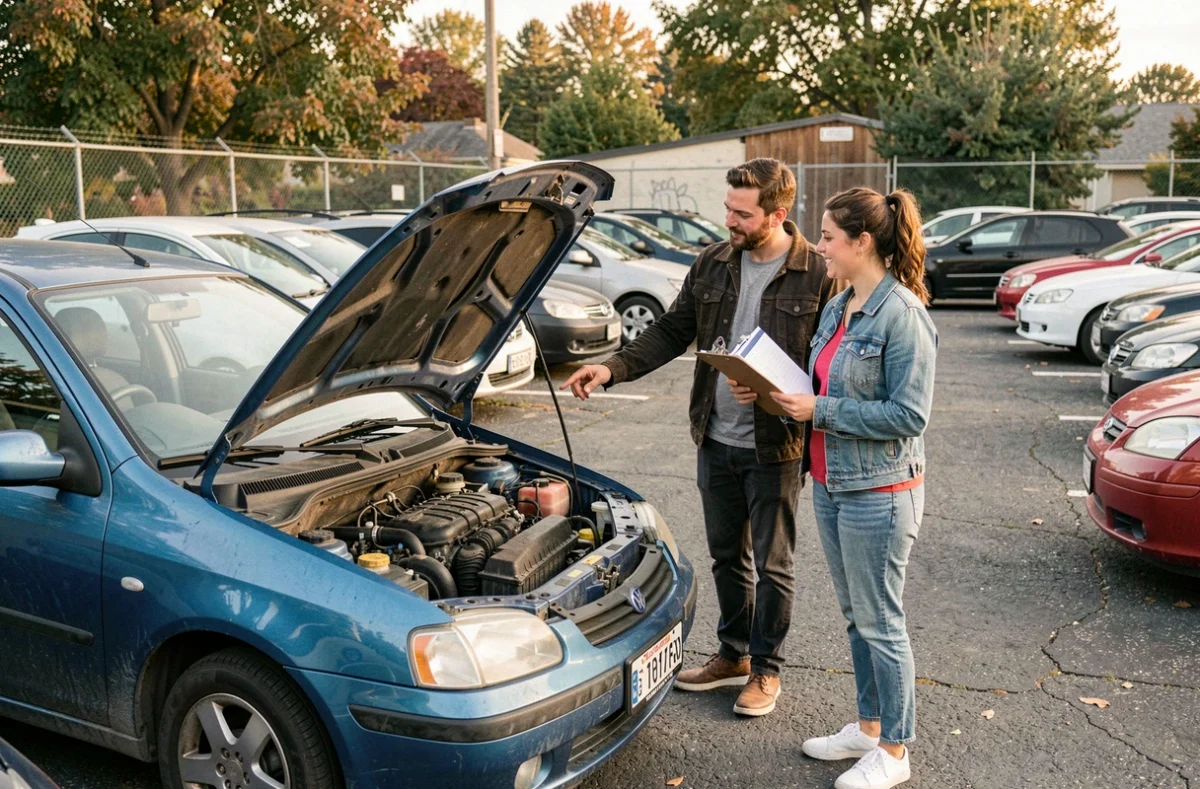
Inspect the bodywork in natural light. Differences in colour between panels can indicate repairs following an accident. Open the bonnet: rust on the chassis rails or oily residue on the engine may point to poor maintenance.
Inside, wear on the pedals and steering wheel should match the stated mileage. A smooth steering wheel and worn pedals on a car advertised with low mileage should raise questions.
What a test drive can reveal
Drive for at least twenty minutes, in a range of conditions: town, open road and uphill. Turn off the radio so you can listen to the engine and transmission.
- A metallic noise when starting from cold may indicate a timing issue
- Steering-wheel vibrations above eighty kilometres per hour may point to a wheel alignment or balancing problem
- A clutch that slips uphill means it may need replacing soon, which can be a significant expense
A very short test drive or one on a route chosen by the seller isn’t enough. Insist on choosing your own route, with a variety of road conditions.
Battery warranty and vehicle warranty: two separate forms of cover for electric cars
For a used electric car, the manufacturer’s battery warranty and the vehicle warranty are separate contracts. A battery that is still in good condition doesn’t necessarily mean its warranty is still valid.
Check how much time and mileage remain on the warranty. Some manufacturers set a minimum remaining-capacity threshold: if the battery falls below it during the warranty period, replacement is covered. Once the warranty expires, the cost falls to the buyer.
Ask for the original battery warranty contract and compare it with the current mileage. This document is more reliable than the seller’s word alone.
Buying from a private seller or a dealer: what each option means
A private seller will often offer a lower price, but without the statutory conformity warranty available from a professional seller. A garage or dealership is liable for hidden defects and, in most cases, must provide a minimum warranty lasting several months.
The right choice depends on how confident you are in assessing the car’s condition. If you’re not comfortable with mechanics, buying from a professional reduces the risk. You can also have a private seller’s car inspected by an independent mechanic before signing: the cost of the inspection is modest compared with the purchase price.
The used-car market offers plenty of choice, from petrol city cars to hybrid SUVs. Take the time to compare models and prices across several sources before committing. Preparing your purchase, checking the documents and taking a proper test drive is still the best way to avoid unpleasant surprises.