
You press the button on your remote control, and nothing happens. No door responds. Before thinking about a key or lock problem, the fuse for the central locking deserves your attention. This small component protects the electrical circuit that controls the simultaneous opening and closing of all the doors of your car. When it fails, the entire system goes silent.
Central locking fuse: an electrical safeguard
The central locking relies on a circuit that is continuously powered. Actuators (small electric motors) are housed in each door. When you press the remote button or turn the key, an electrical signal is sent to these actuators to lock or unlock the locks.
The fuse is placed in series on this circuit. It allows current to pass under normal conditions. If a short circuit occurs (a bare wire in a door boot, for example), the fuse blows and cuts the circuit before the harness burns out. Without it, an overload could damage the actuators, the relay, or even the control unit.
To better understand this protection logic, you can consult the central locking fuse on Carfully, which details the operation and location according to the models.
Symptoms of a blown central locking fuse: distinguishing the real failure
Have you noticed that only one door refuses to lock while the others work? It’s probably not the fuse. A blown fuse blocks all doors at the same time, because it cuts the power to the entire circuit.
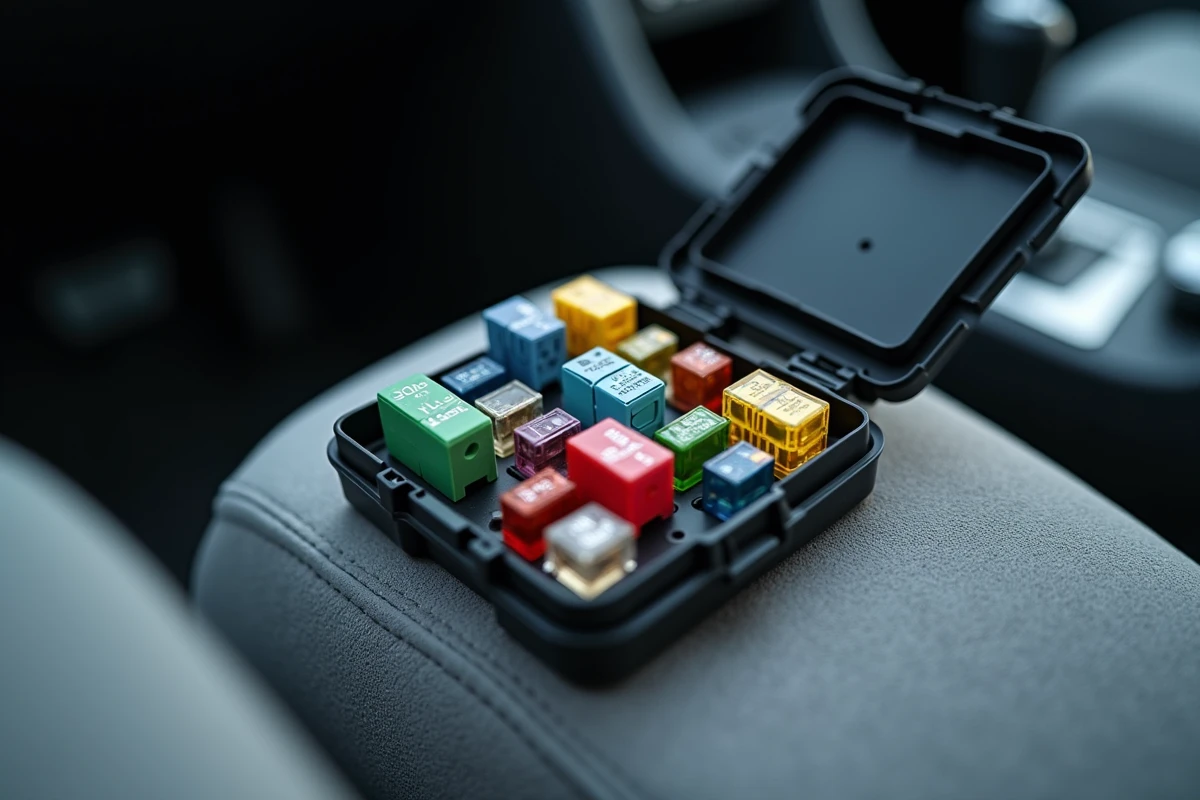
Here’s how to guide your diagnosis based on the symptoms:
- No door responds to the remote button or the interior button: the central locking fuse or relay is likely the cause.
- One door remains inert while the others work: the actuator of that door or a broken wire in the door boot is the main suspect.
- The locking works with the physical key but not with the remote: the remote battery or the radio receiver should be checked first.
This distinction is valuable. Replacing a fuse takes a few seconds, but if the problem comes from a lock actuator or a damaged harness, a new fuse won’t change anything.
Finding the fuse box: not always a single location
In most cars, the interior fuse box is located under the dashboard on the driver’s side. A plastic cover protects it. Sometimes, it is behind the glove compartment or in a side compartment at knee level.
The trap is believing there is only one box. Some models distribute the central locking circuit between two fuse boxes: one in the cabin and one in the engine compartment. On several recent Renaults, for example, you may find a fuse related to central locking under the hood and another inside.
The diagram printed on the cover of each fuse box indicates the function of each slot. Look for the mentions “central locking,” “verrouillage,” “CL,” or a padlock pictogram. If the diagram is not readable, the vehicle’s maintenance manual contains the complete mapping.

Replacing the fuse and diagnosing when it blows again
Removing a fuse requires no special tools. A fuse puller (often provided in the cover of the box) is sufficient. Pull out the suspect fuse and examine it: a melted or blackened filament confirms that it is blown.
Replace it with a fuse of the same amperage. Using a higher amperage is a common and dangerous mistake: the fuse will not blow at the right moment, and it is the electrical harness that will take the overload.
What to do if the new fuse blows immediately
A fuse that blows as soon as it is replaced is not defective. It is doing its job: it signals a problem upstream. A fuse that repeatedly blows indicates a short circuit in the central locking circuit.
The most common causes:
- A crushed or bare wire in the door boot (the flexible sheath between the body and the door, which undergoes flexing with each opening).
- An internally shorted lock actuator, often due to wear or moisture.
- A central locking relay stuck in the closed position, which keeps the circuit powered at all times.
In this case, the diagnosis requires checking the door harness wire by wire, or disconnecting each actuator one by one to isolate the source of the fault. If you do not have a multimeter, a visit to a workshop is necessary.
Remote battery or fuse: do not confuse
Before touching the fuse box, check the battery of your key. A weak battery gives similar symptoms: reduced range, then total lack of response. The difference? With a dead battery, the locking by the interior button still works. If even the button in the cabin triggers nothing, the fuse or relay is at fault.
The modern diagnosis follows a logical order: remote battery, then fuse, then relay, then harness and actuators. Skipping steps often leads to unnecessary replacements.
A central locking fuse costs a few cents and can be changed in less than a minute. But its real value lies elsewhere: when it blows, it tells the state of the circuit. Ignoring this signal is allowing an electrical fault to worsen silently.