You have just chosen a nice anthracite gray for your facade, reference RAL 7016, and you are wondering if this shade will be accepted by the town hall or the Architect of the Buildings of France. The natural reflex is to look for an official list of authorized RAL codes. This reflex often leads to a dead end, as this national list simply does not exist.
The rules governing the color of a facade in France depend on a combination of local documents, not a universal catalog. Understanding this combination allows you to save time and avoid a refusal of prior declaration.
Local Charter and SPR: what replaces the national RAL color chart
The RAL color chart is an industrial tool. It is used to name a shade in a standardized way so that the paint manufacturer and the client are talking about the same color. However, no French regulatory text imposes a valid RAL list across the entire territory.
What determines the authorized colors varies depending on where your house is located. In most municipalities, it is the Local Urban Plan (PLU) that contains the prescriptions. Some town halls attach a color chart to their regulations, sometimes expressed in RAL references, sometimes in samples of local shades.
When the municipality is located in a Remarkable Heritage Site (SPR), the rules change in nature. An SPR has its own preservation and enhancement plan, with often more detailed shade prescriptions. In Paris, for example, two SPRs cover entire neighborhoods and impose palettes that reflect the architectural history of the area.
Before browsing an industrial color chart, you should therefore identify the information related to the RAL color chart and authorized colors for Buildings of France applicable to your specific geographical situation.

Role of the ABF in choosing facade shades
The Architect of the Buildings of France (ABF) intervenes as soon as your project is located in a protected perimeter: around a historical monument, SPR, classified or registered site. Their opinion concerns the entire exterior appearance, including the color of coatings, joinery, and ironwork.
You may have noticed that two neighboring houses in the same village can have different shades, both validated by the ABF? This is because the ABF’s opinion is assessed on a case-by-case basis, depending on the existing building, the context of the street, and the original materials.
Specifically, the ABF does not check a box in a RAL table. They examine the descriptive notice attached to the prior declaration or building permit application. This notice must specify the intended material and the proposed shade, sometimes with a precise manufacturer reference. The instruction is then carried out through the Departmental Unit of Architecture and Heritage (UDAP) of the department.
Why an accepted RAL here may be refused there
A RAL 1015 (light ivory) will be coherent in a limestone village in Burgundy, but unsuitable in an area of half-timbered houses in Alsace. The ABF’s logic is based on harmony with the local heritage, not on an industrial code.
Each department, through its UDAP, sometimes produces advisory sheets that guide choices. In Côte-d’Or, for example, the DRAC publishes recommendations on colors in protected spaces. In Indre-et-Loire, the CAUE offers principles of variation by building type. These local documents are your true compass, much more than a generic color chart.
Prior declaration and color: the concrete procedure
Changing the color of a facade requires a prior declaration of works, even without touching the structure of the building. The control of the shade is now integrated from the submission of the file.
Here are the steps to follow to avoid a refusal:
- Consult the PLU of your municipality at the town hall or online, specifically looking for the article related to the exterior appearance of constructions and any attached color chart.
- Check if your plot is located in a protected perimeter (around a historical monument, SPR, classified site) via the Heritage Atlas or the town hall’s urban planning service.
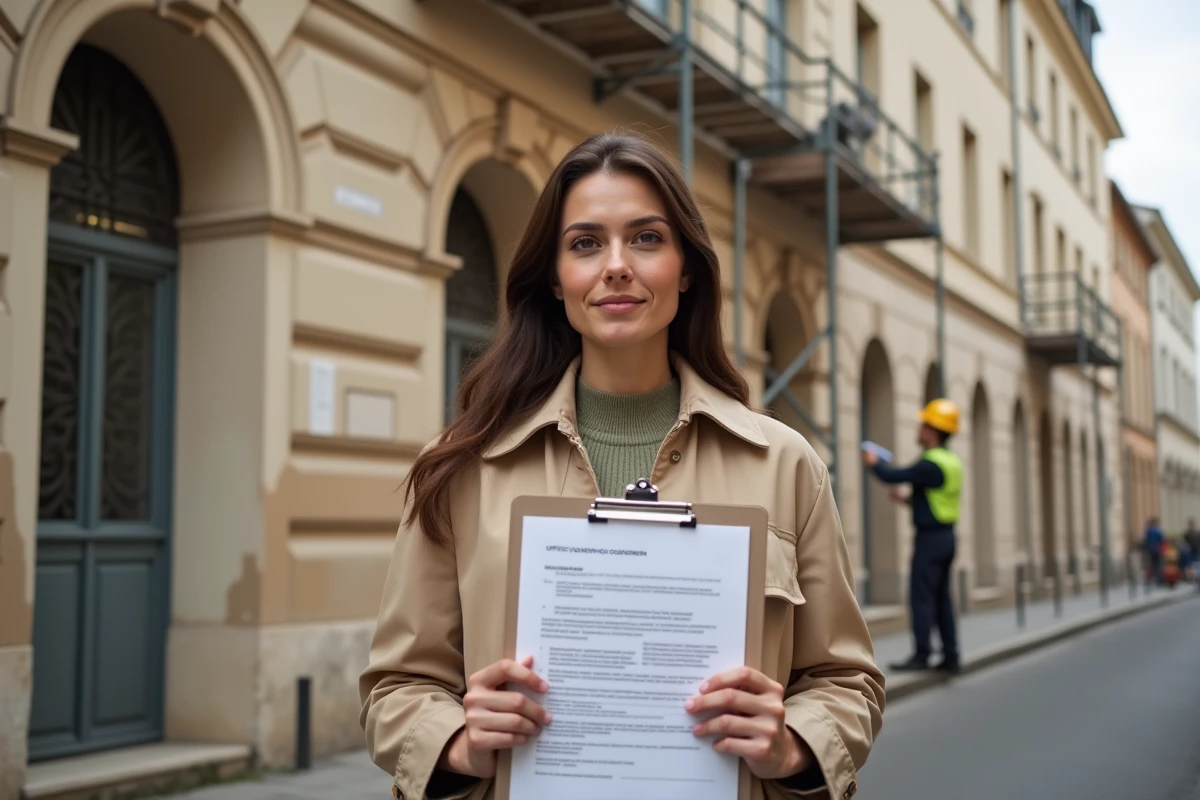
- Prepare the descriptive notice specifying the facade material, the exact shade with its manufacturer reference, and if possible, a sample or visual simulation.
- In ABF areas, anticipate a longer instruction period related to the consultation of the UDAP, and remain available for a discussion with the architect if the proposed shade raises questions.
The descriptive notice is the document where everything is at stake. A vaguely described shade (“light beige”) generates back and forth. A precise reference accompanied by a physical sample facilitates validation.
Joinery and ironwork: shades often distinct from the facade
The color of the facade attracts all the attention, but refusals also concern joinery (shutters, windows, doors) and ironwork elements (railings, grilles). In many PLUs, these elements are subject to separate prescriptions.
In Touraine, traditional practices associate specific shades with shutters according to the type of building: a tuffeau house does not have the same colors for its shutters as a longère with plaster. Each facade element can have its own shade constraint.
Why this distinction? Because joinery creates the visual contrast that defines the character of a building. A shutter in a too bright blue on a golden stone facade from Beaujolais will produce an effect that the ABF or the PLU seeks to avoid.
The right method: start from the existing building, not the color chart
Instead of flipping through a RAL color chart hoping to find the right shade, start from your house. Observe the existing stone or plaster, identify traces of old paint under recent layers (a simple scraping often reveals the original shades), and then propose a palette consistent with what the building tells.
An investigation of the old layers is better than a new catalog. This approach corresponds exactly to what the ABF expects, and it significantly reduces the risk of refusal.
The RAL code remains useful when ordering paint from the manufacturer. It translates into industrial language a choice that must arise from observing the site, reading the PLU, and, if necessary, dialogue with the UDAP of your department.